kitchen background

Saturday, February 27, 2010

30 minute Mozzarella

There is nothing like fresh Mozzarella. It's creamy and melty and oh so good. And, surprisingly, it's something you can make at home. This recipe makes enough for 2-3 pizzas with lots of cheese.


You will need a few supplies. I bought mine at cheesemaking.com. I bought the Cheesemaking kit for Mozzarella and Ricotta, but you could just get rennet tablets and citric acid. You'll need to have the following:


A large stainless steel pot
A food thermometer that goes down to 90 degrees*
A gallon of fresh milk (not ultra-pasteurized)
A strainer
A spoon
Salt or herbs for flavoring
Cheesecloth (optional)*
Rennet Tablets*
Citric Acid*

*these are included in the kit


Directions for Mozzarella

1. Start by getting out all your supplies.

2. Mix 1 cup chlorine free water and 1 1/2 tsp. citric acid.

3. Mix 1/4 cup chlorine free water and 1/4 rennet tablet (just break the tablet into 4 pieces). Stir until dissolved.

4. Add one gallon of milk to the pot. And don't worry, this is going to make a lot of cheese. For the price of a gallon of milk, you will get a large amount of mozzarella. For the price of one gallon of milk (plus your rennet and citric acid), you would probably spend about $6-$8 at the store.


5. Stir in your citric acid mixture vigorously.


6. Heat the milk to 90 degrees while continuing to stir.


7. Remove the pot from the burner and add the rennet solution with an up and down motion for about 30 seconds.


8. Cover the pot and leave it undisturbed for about 5 minutes. Check the curd. It should be thick enough to slice with a knife. If it's not thick enough yet, just put the lid back on and wait another couple of minutes. 
If it didn't form a curd... you're in trouble. (The only time that happened to me was when I accidentally mixed up the rennet and the water solutions.)


9. Cut the curd with a knife. If you look closely, you can see the little slices all throughout. Make sure you use a knife that goes all the way down.


10. Place the pot back on the stove and heat to 110 degrees while slowly moving the curds around with your spoon.


11. Take off the burner and continue slowly stirring for 2-5 minutes. (More time makes a firmer cheese.)


12. Drain the cheese. You can use a cheesecloth inside your strainer to really catch all the little curds. I prefer working without the cheesecloth, but you do lose some of the curds that way.
The next step involves heating the cheese. You can use the microwave or the waterbath method. I use the waterbath method because I'm a little afraid of the microwave. I'm not exactly sure what it does, nutrition-wise, to the food. But that's a subject for another day. If you want to use the microwave, skip to microwave method, below.


13. Heat a pot of boiling water to 185 degrees. 


14. Dip the colander full of cheese into the hot water a few times and let the water drain off. It's easier to work with if you do half the batch at a time.


15. Stir it around with a spoon. Once it starts getting stringy and stretchable, you'll know it's hot enough. If using salt or herbs, add these in now. 


16. Pull it like taffy. Pull and fold over until the cheese gets shiny. Shape into desired shape: a braid, a ball bite size pieces, even string cheese.


17. Put the cheese in ice water for 10 minutes to cool. This will also help it hold its shape.


18. Refrigerate or eat!


Alternate microwave method:
(You may want to wear rubber gloves to protect your hands from hot spots.)
Ladle your curds into a microwaveable bowl, draining off as much whey as possible.
Microwave for 1 minute.
Fold the curds into one piece and add 1 Tbsp. salt or herbs (optional).
Microwave for another 30 seconds. Drain and stretch. If it isn't hot enough, microwave for 30 seconds more. 
Proceed with step 16 above.

Thursday, February 25, 2010

Healthy Crescent Dogs


MMMmmm, crescent dogs. Just pop open the can and roll them around a hot dog and that's all there is to it.
Well, these aren't quite that easy, but what you gain in health is totally worth the extra effort.
Now, I know some of you who are new to real food are thinking, "How can a hot dog possibly be health food?" and wondering if that's a soy dog or something else in there. Nope! That's the real deal. All beef, natural, uncured hot dogs. I found these at Trader Joe's. You want to make sure they are uncured to avoid the nitrates that are used in the processing of most hot dogs. Nitrates (or nitrites) have been linked to cancer and are not a natural food. They are added to preserve the color and make the product (deli meat, hot dogs, bacon) last longer. So if you can find nitrate-free hot dogs, you are eating a tasty, healthy beef sausage. 
I cut the hot dogs into thirds and wrapped each crescent roll around them. We served it as dinner but it would also make a great snack or party food. We dipped them in homemade barbeque sauce.


Crescent Dogs (or Crescent Rolls)

Ingredients

  • 1 (.25 ounce) package active dry yeast
  • 1/4 cup warm water (110 degrees to 115 degrees)
  • 1 cup of water, whey or combination
  • 1 cup butter, melted
  • 1/4 cup sugar
  • 3 eggs
  • 1/2 teaspoon salt
  • 4 cups wheat flour


  • Directions
  1. Stir whey/ water combination together with flour. Let sit overnight.
  2. In a small bowl, dissolve yeast in 1/4 cup warm water. In a mixing bowl, beat butter and sugar. Add eggs, salt and yeast mixture. Stir in enough flour until dough leaves the sides of bowl and is soft (do not knead). Let rise until double (1- 1/2 hours).
  3. Punch dough down. Turn onto a floured surface; divide in half. Roll each portion into a 12-in. circle; cut each circle into 12 wedges. 
  4. Wrap each wedge around a hot dog OR Roll up wedges from the wide end and place with pointed end down on greased baking sheets. Curve ends to form crescents. Bake at 350 degrees F for 20-22 minutes or until golden brown. Remove from pans to wire racks.


Barbeque Sauce
This flavorful sauce can be used as a dip or basted onto grilled meats. Makes about 2 cups.

Ingredients

1 1/2 cups organic ketchup
1/2 cup cider vinegar or red wine vinegar 
1/4 cup soy sauce
1/2 cup packed brown sugar
2 Tbsp. mustard
3 Tbsp. chili powder, or to taste
1 Tbsp. fresh peeled ginger
2 cloves minced garlic
2 Tbsp. olive oil
3 slices lemon


Directions

Combine all ingredients in a medium saucepan and cook over medium heat. Stir often until the sauce comes to a simmer. Reduce heat and simmer for 5 minutes, stirring often. This sauce will keep up to two weeks in the fridge and can also be frozen.


This post is part of Fight Back Friday.

Tuesday, February 23, 2010

Food Rules & giveaway winner!

The winner of Michael Pollan's new book
 Food Rules, An Eaters Manual
 is............
TheWilliamsFamily
Congrats! I'll get in touch with you!
(The winner was chosen by random.org


For those who didn't win, I'll share a few of my favorite rules from the book, how I put them into practice, and share some of my own rules too!

Michael Pollan's Food Rules:

Rule #3: Avoid food products that no ordinary human would keep in the pantry.

I don't know about you, but I don't stock my pantry with any maltodextrin, red dye #5, hydrogenated soybean oil or many of the other ingredients  you see on labels. This rule helps you know what you are eating. It also means that before you eat (or buy) anything, you read the label. For years, I was a diligent label reader. I would scour that "nutrition facts" section for important information- How many calories? How many grams of fat? Now, I don't even look at that part. I just skip right down to the ingredients with one question in mind: what is this? and usually, when I read through that list, I put it right back on the shelf, because it's full of ingredients that are nothing I want in my kitchen or in my food.

Rule #15 Get out of the supermarket whenever you can.

As I've started to change the way I eat, I change the way I shop too. Every Saturday, we pick up locally grown, organic produce from our CSA group. Our beef was raised about 35 minutes away- on pasture- and slaughtered in a local meat shop where I went to pick it up. Our eggs are from happy, truly free range chickens that live outside on a local farm. The local beekeeper was able to tell me what the bees were eating when they produced our honey. There are still many things I buy at the grocery store, and I probably will never totally get away from that, but often healthier, more environmentally friendly choices can be found in other places.

Rule #33 Eat some foods that have been predigested by bacteria or fungi.

Sourdough bread, buttermilk and yogurt count! And someday I may be brave enough to try fermented vegetables.


Rule #39 Eat all the junk food you want as long as you cook it yourself.
Just last night we had a treat. It was homemade lemon pudding. I made it with 3 egg yolks, whole milk, cornstarch, sugar and a lemon. It was creamy and rich and delicious- and guilt free. I reduced the sugar, and the fats were from whole milk and those happy chickens I talked about earlier.  Preparing foods yourself not only means you control what goes in, but in all likelihood means that you'll eat it less often. And even though I make treats, I never make "junk."


My own rules:

Eat as healthfully as you can... but make sure it tastes good.

I learned to make sourdough bread a while back, because I'd read that it's good for you. But the truth is, I've never liked sourdough bread, and even though my husband does, he wasn't a big fan of my sourdough bread;)  So, after a few attempts, I realized: it may be healthy, but it doesn't do us any good if no one will eat it! If you've read my thoughts on sugar, you know that I don't think that's a good-for-you food... but it does make things taste good. I continually try to cut back, but honestly, I'll probably never eliminate it altogether because it is important to me that things taste good!

Eat food the way God intended it to be eaten.

I'm pretty sure corn was meant to be eaten as... corn. Or maybe ground into corn flour or corn meal. That's a lot different than the chemical process involved to make something like high fructose corn syrup or maltodextrin. I eat the whole egg, not just the white. Whole milk instead of skim. Wheat flour instead of white flour. As much as possible, I eat foods whole, because that is how God made them.

This post is part of Real Food Wednesday and Pennywise Platter Thursday.

Monday, February 22, 2010

Desert Island Dish

Last week I posed the question: What one food would you bring to sustain life on a desert island?

It was interesting reading your ideas. If I had to choose one food to bring on a desert island, I'd bring raw milk. Here's why:

What is Raw Milk?

Raw Milk: The kind of milk you would drink if you had a cow. It's just milk, with nothing added or done to change it.
Store bought whole milk: homogenized and pasteurized. Homogenized means that they mix it really hard so that it won't separate. Every cup of milk is the same consistency. Pasteurized means that the milk is heated to kill bacteria.

At first glance, you may think that whole milk would be the better choice. I mean, every glass is consistently creamy, right? And we killed off bacteria, so we won't get sick. Sounds good, right? Not really...

Raw vs. Store Milk

Pasteurization kills off enzymes, vitamins and minerals. These are all found in abundance in raw milk. In fact, enzymes make raw milk so much easier to digest that it doesn't cause lactose intolerance in people who are prone to it.


Good Source of Fat, Protein and Carbohydrates

Raw whole milk is a good source of healthy, saturated fat. We need saturated fat for energy, for reproduction, to protect our immune system, even for our cells to function! 
Raw milk contains proteins. We need to take protein to help our body replenish and repair muscles, cell walls, tissues, bones and nerves. 
Raw milk also contains carbohydrates, used for energy, and also for the nervous system to function.

What about safety?


I know some people are scared of drinking raw milk. I had similar concerns at first. I worried that we needed milk to be pasteurized to make it safe to drink. But if you think about it, people have been drinking milk for thousands of years, and routine pasteurization of milk only began in the U.S. in the mid 1900's.

A little history...
Cows natural diet is grass. But in the mid-1800's they had an idea. There were many thriving distilleries making whiskey, and that produces left over "swill"- hot, mashed up grain. Some unscrupulous distillery owners decided to feed it to the cows. The cows were packed in crowded, unsanitary pens, eating unnatural food. This milk was then sold and drunk raw. People got sick. Children and babies died. So the government stepped in and came up with a solution: make laws that the cows eat a healthy diet? No! Just heat the milk and kill any pathogens that might be in there.

Drinking milk from cows fed a healthy diet of grass is a lot different that eating "swill milk" (or corn milk for that matter).  Healthy cows produce healthy milk. If safety is still a big concern to you, I recommend reading the powerpoint "A Campaign for Real Milk."

Raw milk diet


In the early 1900s at the Mayo clinic, a raw milk diet was prescribed. Patients drank raw milk exclusively to cure and treat several diseases. The following was written in 1929 by J.R. Crewe, MD about his experiences treating patients with raw milk:

"The treatment is used in many chronic conditions but chiefly in tuberculosis, diseases of the nervous system, cardiovascular and renal conditions, hypertension, and in patients who are underweight, run-down, etc. Striking results are seen in diseases of the heart and kidneys and high blood pressure. In cases in which there is marked edema, the results obtained are surprisingly marked. This is especially striking because so-called dropsy has never been treated with large quantities of fluid. With all medication withdrawn, one case lost twenty-six pounds in six days, huge edema disappearing from the abdomen and legs, with great relief to the patient. No cathartics or diuretics were given. This property of milk in edema has been noted in both cardiac and renal cases.

Patients with cardiac disease respond splendidly without medication. In patients who have been taking digitalis and other stimulants, the drugs are withdrawn. High blood pressure patients respond splendidly and the results in most instances are quite lasting. The treatment has been used successfully in obesity without other alimentation. One patient reduced from 325 pounds to 284 in two weeks, on four quarts of milk a day, while her blood pressure was reduced from 220 to 170. Some extremely satisfying results have been obtained in a few cases of diabetics.

When sick people are limited to a diet containing an excess of vitamins and all the elements necessary to growth and maintenance, which are available in milk, they recover rapidly without the use of drugs and without bringing to bear all the complicated weapons of modern medicine."

Not only would you survive on a desert island with only raw milk to drink, you would thrive.

I'll finish with a quote from raw-milk-facts.com: "Raw milk from grass-fed cows is a complete and balanced food. You could literally live on it and nothing else for the rest of your life."

Saturday, February 20, 2010

Arthur episode: what food would you choose?


My kids watched this episode of Arthur recently. I'm including the video in case you want to watch it. For those of you who get enough kids television ( I know I do!), I'll give you the gist of it.

Mr. Ratburn gives his students an assignment. They are supposed to choose one food that they would bring to a desert island. They need to choose the food that would sustain life as long as possible if this was their only food.

Interesting question. The kids come up with a few different answers:

Buster decides to bring ice cream. Mr. Ratburn says that this choice gives you "calcium, but not enough vitamins, fiber or protein."

Francine chooses BBQ potato chips. Mr. Ratburn is worried about the salt content of those.

Arthur wants to bring breakfast cereal. His teacher says, "How long can anyone survive on sugar and yellow dye #5?" He says that this choice gives carbs, but with far too much refined sugar and too little protein.

In the end, the kids get together and each bring one food from one of the food groups. They explain that you need a lot of different foods to be healthy.

I think most of us would agree that we wouldn't want to live off of one food for the rest of our lives. But, back to the original assignment-- what one item would sustain life for the longest? And what one item would you bring?

I'll post my answer on Monday, based on some recent reading I've done. I'd love to hear your thoughts on the subject and see what food you would choose!

And don't forget to enter my giveaway for Michael Pollan's new book. It ends 2/22.

Thursday, February 18, 2010

How to make buttermilk & Soaked Buttermilk waffles recipe

Buttermilk

Buttermilk is so easy to make and costs less too. You can use store bought buttermilk for a starter, as long as it is real cultured buttermilk. Use the freshest buttermilk you can find.


1. In a clean quart jar, add 6-8 ounces cultured buttermilk.
2. Fill the jar with milk.
3. Shake.
4. Leave out at room temperature until the buttermilk has gotten thick and coats the sides of the jar, usually 8-12 hours.
5. Take out a portion to use for your next starter. Refrigerate.


Soaked wheat recipes make the wheat easier to digest and better for you. (For more details on soaking grains, check out Kitchen Stewardship.) When you soak your flour, you start the night before. It just takes a short amount of time, but helps a lot with the morning rush. You already know what you're having, and with a good hot breakfast all planned, you're less likely to reach for the packaged breakfast cereal. 


Soaked Buttermilk Waffles with Orange Syrup


The night before:
In a large bowl, mix 2 cups wheat flour and 2 cups buttermilk.


The next morning, add:
2 eggs
2 tsp. baking powder
1 tsp. baking soda
1/2 tsp. salt
1/3 cup melted butter


Mix well and cook in a hot waffle iron.  You will notice the texture of the batter is a little different (gooey-er than regular waffles)-- don't be scared, when cooked the texture is just right. When you soak the flour the night before, it makes the waffles lighter, even though they are made with all whole wheat flour.


Orange Syrup

1 1/4 cups fresh orange juice (about 3 oranges)
1 Tbsp grated orange peel
4 1/2 tsp. cornstarch
1/2 tsp salt
1/4 cup sugar


Blend all ingredients in a small saucepan. Cook over med-high heat, stirring frequently, until thickened.


I like to juice and grate my oranges ahead of time and save them in baggies in the freezer. Then, I just thaw a pack and add the other ingredients in the morning. This has such a fresh citrus flavor- it is so good!


Don't forget to enter the giveaway for Michael Pollan's new book- it ends 2/22, so be sure to enter before then!


This post is part of Pennywise Platter Thursday.

Monday, February 15, 2010

My first giveaway!

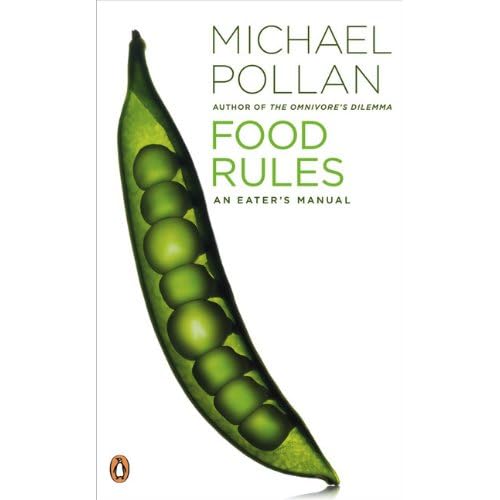
Food Rules 
An Eater's Manual
by Michael Pollan

Product Description from Amazon:
A pocket compendium of food wisdom-from the author of The Omnivore's Dilemma and In Defense of Food 

Michael Pollan, our nation's most trusted resource for food-related issues, offers this indispensible guide for anyone concerned about health and food. Simple, sensible, and easy to use, Food Rules is a set of memorable rules for eating wisely, many drawn from a variety of ethnic or cultural traditions. Whether at the supermarket or an all-you-can-eat-buffet, this handy, pocket-size resource is the perfect guide for anyone who would like to become more mindful of the food we eat. 


This is the book that Michael Pollan talked about when he was on Oprah recently. Below is a clip from the show. Michael Pollan talks with Oprah about a few of the rules in the book, and the Western Diet.


Here's how to enter to win a copy of Food Rules. You get one entry for each of the following, for a total of up to 3 entries:


1. Subscribe in a reader or via email to Simply Real (or tell me if you already do).
2. If you have a blog or website, post about this giveaway linking back to this post.
3. Make a comment on any previous post on Simply Real.


Be sure to post a comment below telling me everything you did.  I'll choose a winner on February 23rd, so be sure to have your entries in by midnight on February 22nd. This giveaway is only open to residents of the continental U.S.